Home Buying
Plumbing Checklist Before Buying a Home Here
A standard home inspection covers a lot and skips the two things that cost the most. Here is what to look at yourself, and what to pay someone to look at.

Standard home inspections are genuinely useful and cover a great deal. They also stop at visible plumbing, which means the two most expensive plumbing items on any property — the buried sewer lateral and the condition of the supply piping inside the walls — get, at best, a note recommending further evaluation.
This checklist covers what you can look at yourself during a showing, what is worth paying for during the inspection period, and what the answers actually mean in this specific market.
The advice differs a lot between a 1978 house near Woods Creek and a 2006 house in Talamore, so it is organised that way.
Ten minutes you can spend at the showing
None of this requires tools and all of it is legitimate to do while walking a house.
- Look at the pipe near the water heater. Dull grey steel with threaded fittings that a magnet sticks to is galvanised — in a 1970s house that is a repiping conversation. Copper is soldered and unmistakably copper-coloured. PEX is flexible plastic, usually red and blue.
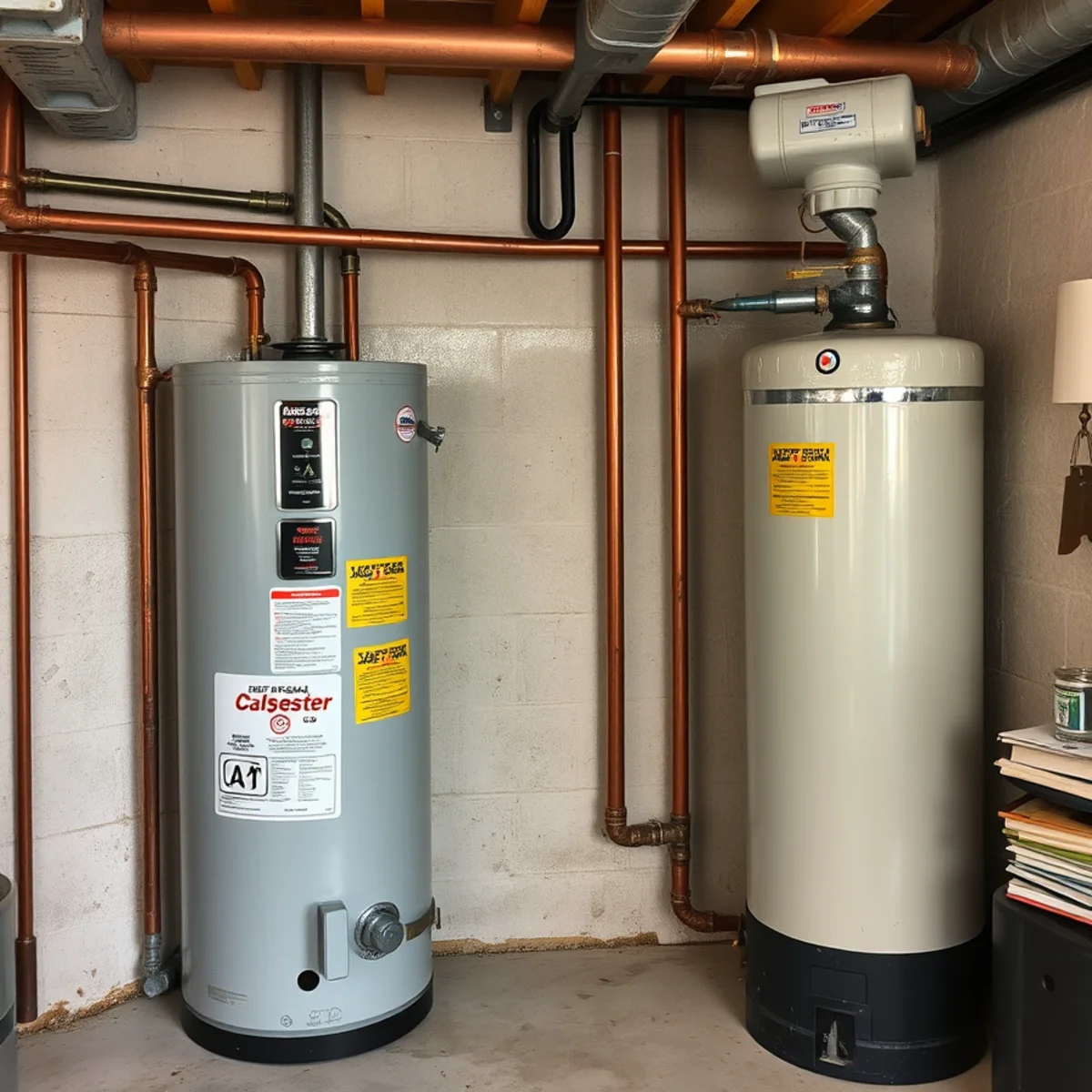
- Find the water heater's data label and read the serial number for a manufacture date. Most brands encode week and year in the first four digits. Anything past eight years in this water is on borrowed time.
- Ask whether there is a water softener, and look at it. No softener in Lake in the Hills or Huntley means every appliance in the house has been drinking 26 to 28 grain water since it was installed.
- Run the hot tap in the furthest bathroom for two minutes. Note how long hot water takes to arrive and whether it stays hot.
- Flush a toilet and run a nearby sink at the same time. A noticeable pressure drop suggests undersized or restricted supply.
- Look for a whole-home shutoff valve. Many pre-1995 homes here do not have one, and that is worth knowing.
- In the basement, look at the sump pit. Is there a pump? A backup? Does the discharge go somewhere sensible outside, or three feet from the foundation?
- Look for a floor drain and check for staining around it. Discolouration in a ring around a basement floor drain means water has come up out of it before.
What to pay for during the inspection period
Two things, and in an older home the first one is not optional.
A sewer camera inspection. Your general inspector will not do this. In older Lake in the Hills, Crystal Lake, Cary and McHenry neighbourhoods, the laterals are frequently clay tile with a joint every few feet, under trees that have had sixty years to find them. A camera costs a small fraction of a replacement, and finding a problem now means a credit or a repair rather than a bill you inherit. Our sewer camera inspection page explains the process, and what a camera reveals before you buy covers what the footage actually shows.
A water test if the property is on a private well. Anything outside village limits — parts of Bull Valley, Prairie Grove, rural Woodstock and Marengo — has no published water quality report. Hardness, iron, pH and total dissolved solids determine what treatment the house needs, and iron in particular changes the whole equipment picture.
If the house was built in the 1970s or early 1980s
The dominant question is the supply piping. Galvanised steel was common in this era and it corrodes from the inside out, closing down until a three-quarter-inch pipe has half an inch of actual opening left.
The symptoms to test for: weak pressure at every fixture at once rather than just one, and rusty or brown water from the hot tap first thing in the morning. If the seller says the pressure is 'just how it is', that is the pipe.
Also expect cast iron drain stacks, which thin from the inside over decades, and a clay sewer lateral. Neither is a reason not to buy — plenty of these are excellent houses — but a repipe is a real number and it belongs in your budget rather than in your first surprise. Our whole-home repiping page covers what that looks like.
If the house was built in the 1990s or 2000s
This is the bulk of the housing stock in Lake in the Hills and most of Huntley, and the questions are completely different.
The pipe is fine. It is copper or PEX, the drains are PVC, and structural failures are rare. What is not fine is the equipment, because in a phase-built subdivision everything went in the same year and it all ages out together.
So the questions are: how old is the water heater, how old is the sump pump, is there a backup, and is the softener adequately sized. That last one is the most commonly missed. Builder-installed softeners in this area were routinely specified for average hardness rather than the 26 to 28 grains we actually have — a unit that regenerates almost daily and still leaves spots on the glassware was too small from day one, and no amount of servicing corrects a capacity problem.
Budget accordingly. A house of this era with original equipment is likely looking at a water heater, a sump pump and a softener within a few years of purchase. None of those is a crisis; all of them are money.
The red flags that are worth walking away over
Most plumbing findings are negotiable. A few deserve more caution.
Obvious unpermitted work, particularly gas piping or a basement bathroom that was clearly added by an owner. Not because it cannot be corrected — it usually can, and our code violation corrections page covers that — but because it tells you what else in the house may have been done the same way.
Repeated water staining in a finished basement, especially around a floor drain. That means backups have happened, and if the cause is a surcharged municipal main it will keep happening until someone installs flood control.
A seller who will not permit a sewer scope on a pre-1980 house. There is no good reason to refuse it.
Fresh paint on one basement wall, or a section of new drywall with no explanation. Ask directly what was repaired and whether there is documentation.
What to do with what you find
Almost none of this should end a deal. It should adjust the price or produce a credit.
A failing sewer lateral, a house on galvanised supply, or a water heater at year twelve are all quantifiable. Get a written estimate during your inspection period and take it to the negotiation. Sellers routinely credit repairs they would otherwise have to make for the next buyer.
What you want to avoid is closing without knowing. The expensive version of every item on this page is the one discovered in month four, at full price, with no leverage and no budget set aside.
We are happy to walk a property during an inspection period and give you an honest read on what you are buying into. That conversation costs nothing and it is a considerably better use of an hour than the alternative.
Quick answers
Does a home inspection include the sewer line?
No. Standard home inspections stop at visible plumbing. The buried lateral between the house and the municipal main is only inspected if you specifically hire someone to run a camera down it, and in an older neighbourhood that is the highest-value add-on available.
What plumbing should I check when buying a house in Huntley?
In Huntley's phase-built subdivisions the pipe is generally sound, so focus on equipment age: the water heater's manufacture date, the sump pump and whether it has a backup, and whether the softener is properly sized for 26 to 28 grain water. Builder-installed softeners here are commonly undersized.
How do I know if a house has galvanised pipes?
Look at the pipe near the water heater. Galvanised is dull grey steel with threaded fittings and a magnet sticks to it. Combined with weak pressure at every fixture and rusty morning water, that is a repiping conversation to price before you close.
Need a hand with this?
Talk to the plumber who wrote this
We are a licensed, owner-operated shop on Pine Street in Lake in the Hills. Free written estimates on non-emergency work, and a real person answering the phone when it cannot wait.
- 5.0 from 11 Google reviews
- Licensed & insured
- 24/7 emergency service