Emergency
How to Shut Off Your Water in a Plumbing Emergency
The five minutes between a pipe failing and the water stopping determine whether you have a repair or a remediation. Here is how to win those five minutes.
Go find your main shutoff valve right now. Seriously — before you finish this article.
The reason is arithmetic. A half-inch supply line at typical household pressure moves several gallons a minute. Five minutes of that is manageable with a wet vac. Two hours of it, while you search the basement with a flashlight and then wait for someone to arrive, is a restoration claim.
The single biggest predictor of how bad a plumbing emergency gets is whether the homeowner knew where the valve was and whether it turned.
Step 1: Find the main shutoff
In most Lake in the Hills homes, the main shutoff is inside on the front foundation wall, near where the service line enters from the street, usually within a few feet of the water meter.
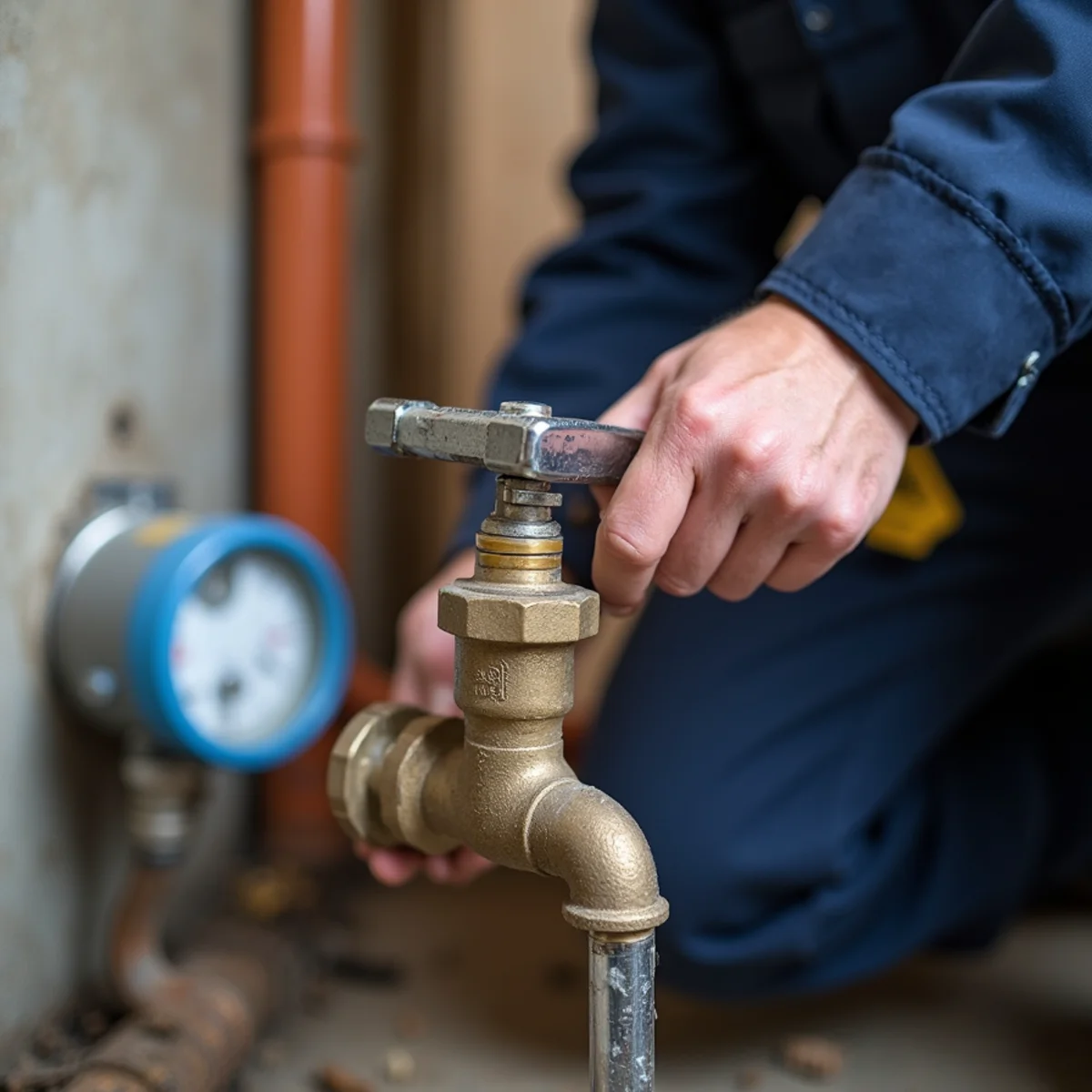
Look for a pipe coming up through the floor or in through the wall, with a valve on it. It will be either a round wheel handle (a gate valve) or a straight lever (a ball valve).
In homes with a crawl space rather than a basement, it may be near the water heater or in a utility closet. In some older homes it is in an odd spot — under a stairway, behind a furnace, inside a finished wall access panel.
Once you find it, put a bright tag on it. Then show everyone in the house.
Step 2: Know how to turn it
A ball valve has a lever. Turn it a quarter turn so the lever sits perpendicular to the pipe. Perpendicular is closed. This is fast and unambiguous, which is why it is the modern standard.
A gate valve has a wheel. Turn it clockwise — righty tighty — and keep turning. It can take many full rotations to close completely. Do not force it past where it stops.
Test it now, on an ordinary day. Close it, confirm the water stops at a faucet, then reopen it. A valve that has never been moved in fifteen years is exactly the valve that will not move when you need it, and finding that out during an emergency is the worst possible time.
Step 3: Know the fixture stops too
Not every emergency needs the whole house shut down. Every toilet has a small valve on the wall behind it. Every sink has one or two under the cabinet. Washing machines have hot and cold valves behind them.
If the problem is one fixture, closing its stop lets everyone else keep using water while you sort it out.
These small valves are also the ones most likely to seize in hard water. Exercise them once a year — closed and back open — and replace any that weep or will not close. It is inexpensive work and it pays for itself the first time you need one.
If the main valve will not turn
Do not force it hard enough to snap the stem. A broken valve on a live line is dramatically worse than a stuck one.
Instead, look for the curb stop — the buried valve out toward the street, usually under a small metal cap in the parkway. It requires a long key and, in most cases, the Village. Call the Village's water department non-emergency line; many will come shut the curb stop.
In the meantime, use fixture stops to isolate what you can, and get containment going — buckets, towels, and a wet vac if you have one.
And once the crisis passes, replace that valve. A main shutoff that does not shut off is not a shutoff.
If your home has no interior main shutoff at all
This is more common than people expect in Lake in the Hills homes built before the mid-1990s. There is a curb stop at the parkway and nothing accessible inside.
That means during a failure you have no way to stop the water without the Village. It is genuinely the difference between a several-hundred-dollar repair and a five-figure remediation.
Adding an accessible main shutoff is not expensive and does not require a repipe. It is one of the highest-value small jobs available to an older home here, and we will do it as a standalone visit. Our repiping and whole-home plumbing page covers it, along with the other upgrades worth bundling if the walls are ever open.
After the water is off
Open the lowest faucet in the house — usually a laundry or utility sink — to drain the pressure and remaining water out of the pipes above it. That stops the residual dribble from a break upstairs.
If water reached anything electrical, kill those circuits at the panel, but only if you can reach the panel from a dry spot.
Photograph everything before you clean. Move cardboard and anything absorbent off the floor.
Then call. Emergency plumbing service is available around the clock, and when you call we will confirm the water is actually stopped before anything else — because that is worth more than anything we do after we arrive.
The upgrade worth considering
WiFi leak sensors cost very little and go under every sink, behind toilets, next to the water heater, at the washing machine and in the sump pit. They text you at the first cup of water rather than the first hundred gallons.
Automatic shutoff valves go further. They mount on the main, watch flow patterns, and close the water themselves when they see something that behaves like a burst rather than a shower. For anyone who travels, owns a second property, or has finished space below grade, they are among the best-value plumbing products available.
Neither replaces knowing where your valve is. But together they cover the scenario nobody plans for: the failure that happens while the house is empty.
Quick answers
Where is the main water shutoff in most Lake in the Hills homes?
Usually inside on the front foundation wall, close to where the service line enters and typically within a few feet of the water meter. In crawl-space homes it may be near the water heater or in a utility closet instead.
Which way do I turn the water main to shut it off?
A lever-style ball valve closes with a quarter turn so the handle sits across the pipe. A wheel-style gate valve closes clockwise and may need many full turns. Test yours on a calm day so you know which you have.
What if I cannot find any shutoff valve inside my house?
Many older homes here genuinely do not have one. The curb stop at the parkway requires a special key and usually the Village. Adding an accessible interior shutoff is inexpensive and is one of the highest-value upgrades an older home can get.
Need a hand with this?
Talk to the plumber who wrote this
We are a licensed, owner-operated shop on Pine Street in Lake in the Hills. Free written estimates on non-emergency work, and a real person answering the phone when it cannot wait.
- 5.0 from 11 Google reviews
- Licensed & insured
- 24/7 emergency service